

 Justin Hall went to sleep on a September 2024 night thinking Hurricane Helene would miss them. He had checked the forecast and decided Grovetown, Georgia, the quiet community outside Augusta where he lives, was probably in the clear.
He was wrong.
“When Helene hit, when I went to sleep that night, I thought that it was going to miss us,” Hall recalled. “And at some point, it turned [north] and came up.”
Hall, 38, is an Army veteran who trained as an explosive ordnance disposal specialist, one of the most dangerous roles in the military. In 2019, his life changed completely when he was diagnosed with a rare autoimmune disease that caused swelling from his cervical spine down to the base of his spine.
He walked into the emergency room on his own two feet. After two weeks in a medically induced coma, he woke up completely paralyzed and dependent on a ventilator and feeding tubes. Today, he’s a member of the Paralyzed Veterans of America’s Southeastern Chapter and uses a wheelchair to navigate life and participate in adaptive sports.
Helene Hits
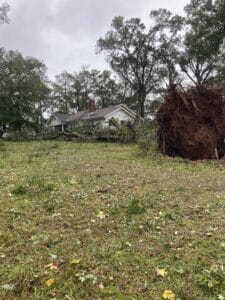
By 3:00 a.m., Hurricane Helene was directly on top of Grovetown. It had pivoted unexpectedly, driving a wall of wind and debris straight into a neighborhood that wasn’t prepared for it. Hall and a friend were downstairs when the sounds started — the deep, structural groaning of a house under siege.
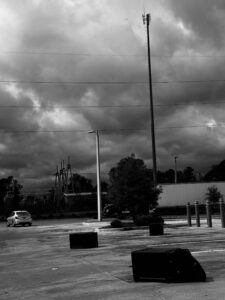 “It sounded like my house was breaking in the center, and boards were popping,” Hall said. “Me and my buddy were downstairs joking about how we were about to die, not realizing that the hurricane was right there.”
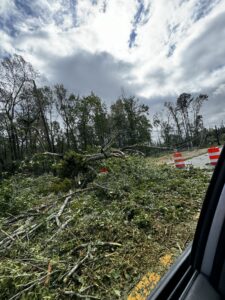
When morning came, the full scope of the disaster became clear. About 20 trees had fallen across the only road in and out of the neighborhood, cutting off every resident. But for Hall, the isolation carried a weight that his neighbors could not fully understand. His world had been carefully arranged around his disability — his home modified, his routines adapted — and the storm had dismantled those adaptations in a single night.
The power outage that followed lasted nearly a week. For most residents, that meant spoiled food and dark rooms. For Hall, it meant something more problematic. His stair lift, the device that allows him to access both floors of his own home, was unusable without electricity. He was effectively stranded within a space that was supposed to be his refuge.
“I would have to scoot up and down my stairs to get outside or up to my bedroom,” he said.
Hall’s situation highlights a vulnerability that rarely makes it into disaster coverage. For people with physical disabilities, a natural disaster is not just a public emergency, it is a deeply personal one. The systems, tools, and modifications that enable independence in daily life are precisely the things most likely to fail when the power goes out or the infrastructure breaks down. Wheelchair ramps become obstacles when debris blocks them, stair lifts become useless without electricity, and people who rely on power-dependent medical equipment for survival face what amounts to a countdown clock when there’s nothing to power them.
 Recovery and Resilience
The financial blow compounded the physical impact. The $400 in groceries Hall purchased right before the storm was wiped out entirely. When residents turned to Federal Emergency Management Agency for relief, the response was limited because Georgia was not declared a federal disaster area the way North Carolina was. The assistance available was far less than what many households needed.
That’s when Hall turned to PVA. Through PVA’s disaster relief fund, he learned he could apply for an emergency grant. He filled out a form, submitted receipts, and found the process straightforward—a contrast to the four years he spent fighting the VA to get a migraine claim approved before PVA intervened on his behalf.
With grant funds arriving in about two weeks, Hall replaced his groceries and purchased a small generator to power his stair lift. He also bought solar-powered fans and battery banks that can be used to weather future storms.
“If a storm hits here again, I don’t have to scoot up and down the stairs unsafely,” he said.
PVA’s role in Hall’s life extends beyond disaster relief. The nonprofit has been part of his recovery since 2019 during his inpatient therapy at Charlie Norwood VA Medical Center in Augusta. It connected him to adaptive sports such as pickleball, wheelchair basketball, rugby, and skiing. It helped him navigate a VA system that had denied his migraine claim for years, ultimately winning his appeal.
The hurricane relief reinforced what Hall already knew: PVA shows up for veterans not only in rehab centers or on athletic courts, but also in the moments of crisis when support is needed most.
I'm truly grateful that the PVA was there or I wouldn't have had food or a safe way to get up and down my stairs,” Hall said. “You can't put a price on independence.”
For Hall, surviving Hurricane Helene was not just about weathering a storm. It was proof that for paralyzed veterans navigating a world not always accessible to them, having an organization in your corner, one that understands the particular and often invisible vulnerabilities that come with disability, can make all the difference between dangerously sliding down a dark staircase and making it to safety on the other side.
Learn more about PVA's disaster grants.