

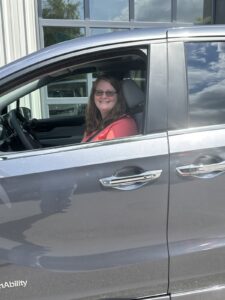
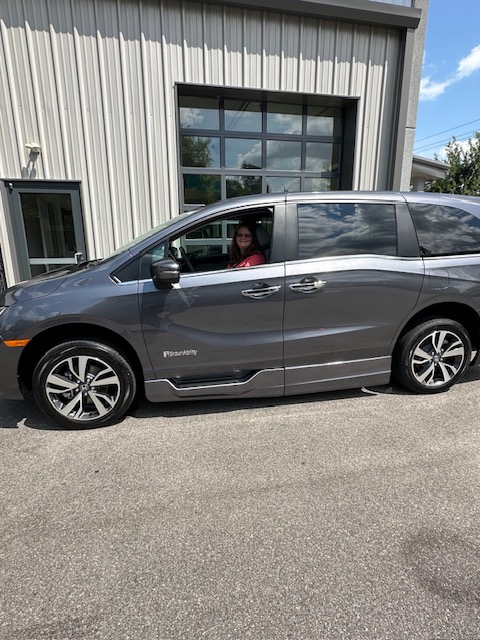
On a humid afternoon in Georgia, Amy Dotson sat behind the wheel of her 2024 Honda Odyssey and smiled at the quiet hum of independence.
Dotson, a member of Paralyzed Veterans of America's Southeastern Chapter, enjoys a life full of advocacy, adaptive sports, and miles on the open road. But the path there was long, winding, and challenging.
Amy medically retired from the Air Force in 2015. She began her service in December 2000 as a cryptologic language analyst, translating Arabic and French into English. It was demanding, precise work—exactly the kind she loved.
Shortly after the birth of her daughter in the early 2000s, strange symptoms began creeping in. Years passed with cycles of being "mostly fine" followed by stretches of alarming symptoms. In 2009, Dotson was diagnosed with fibromyalgia, a chronic condition that causes widespread pain, fatigue, and mood disturbances, but it didn't explain everything.
The episodes escalated: bladder and bowel issues, grip weakness, vertigo. In 2014, after she fell and fractured her hand, an MRI revealed lesions, and a spinal tap confirmed the diagnosis: multiple sclerosis.
"I thought that I would be more upset hearing that diagnosis," she said. "But … I was relieved because I finally understood why all those strange things were happening."
For about 10 years, she had been told her symptoms were in her head.
“I finally had a name. I’d been told that it was all in my head, and I finally had pictures where, yes, it was all in my head. But now I can show exactly where,” she said.
The Air Force was already preparing to send her to a medical evaluation board due to fibromyalgia and post-traumatic stress disorder diagnoses. MS clarified what her body was signaling all along. She medically retired from the service in September 2015.
PVA Stands in Her Corner
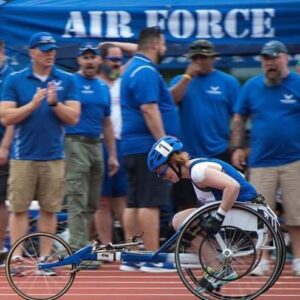
Dotson's transition to civilian life was harder than she expected. Adaptive sports through the Air Force Wounded Warrior Program helped at first—she competed in the Warrior Games and the Invictus Games—but those programs primarily serve active-duty service members. Once permanently retired, she needed something more lasting.
That's when PVA entered her life in a new way. She first encountered PVA years earlier, volunteering at a bass fishing tournament with her unit.
"I had no idea that one day I would become a member," she said. "I would have taken more time with the veterans to hear their stories and to appreciate their journey."
 Years later, it would be her own journey that needed support.
As her MS progressed, driving became difficult. After another fall—this time breaking her right foot in three places—she could no longer safely manage a standard vehicle. She learned about the VA's adaptive auto grant and began applying on her own in 2018. Denials followed. Then more denials.
The problem was language, specifically how the VA defined "loss of use."
"[Loss of use] doesn't mean that I can't use my feet for anything," she said. "It means that I don't have more function in my feet than someone who has prosthetics."
For conditions like ALS or certain spinal cord injuries, approval can be straightforward. For MS, the spectrum of symptoms makes it more subjective.
"I was feeling very discouraged for a long time because I kept getting denied," Dotson said.
With the help of PVA National Service Officer Michael Sheets, everything changed. Sheets combed through her medical records and identified a clear and unmistakable error in the VA's own documentation.
"We didn't need anyone to come in and say anything new," Dotson said. "Everything was already there. He just showed them that it was already there."
More than paperwork, Sheets gave her something deeper.
"All I needed was some hope and someone standing in my corner to fight for me."
About a year after the successful application process began in 2022, she received her van. She chose a Honda Odyssey, and she's put 23,000 miles on it in less than two years.
"I absolutely love it," she said. "I'm no longer staying home. I felt like my life had been held hostage, because I was at everyone else's mercy if I wanted to go anywhere. And I finally have my own independence, and I can go where I want, when I want."
That independence rippled outward. "I felt for a long time that my relationships with other people were unbalanced. I was needing help all the time and I was used to being the helper."
Now, she can volunteer again because she has a new level of independence that she didn't have before receiving her adaptive van.
Amy Goes Everywhere
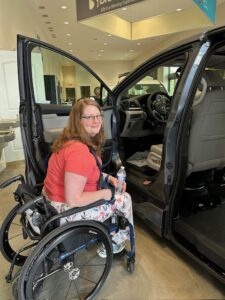 In the past year alone, Dotson has participated in PVA’s National Veterans Wheelchair Games in Minneapolis, attended the Women Veterans Empowerment Retreat (WVER), and traveled to Washington, D.C., for PVA’s Legislative Seminar to meet with lawmakers and staffers about issues affecting veterans with disabilities.
“It’s very nice to be able to roll into an event and you don’t have to explain a lot of things. Everyone just knows because they’ve lived it as well. You already have a foundation of understanding to build upon,” she said.
Women-centric events hold a special place for Amy. She traveled to WVER in 2025 drawn by a desire to find other women who share her deep commitment to honoring and strengthening the bonds of military service and community.
“The energy at WVER was contagious. Women supporting women, learning about issues that directly impact our lives, and making new connections with others who understand the shared woman veteran experience,” she said. “It was powerful and uplifting, and yes, it was empowering to me to utilize my leadership experience to keep giving back and moving forward with PVA. My time in uniform might have come to a close, but my call to serve is as strong as ever.”
Finding Purpose and Community Again
Being part of PVA has restored something Dotson feared was lost when she retired from the Air Force.
“Being a member of the PVA has given me purpose again,” she said. “It is something that I was starting to lose.”
While she was on active duty, being an airman was central to her identity. After her medical retirement, she struggled to replace that sense of belonging.
“I want to be a part of something bigger than myself. And being a member of the PVA has given that to me. I have found that I belong again. I have a community again.”
In military communities, she says, when someone tells you to call if you need something, they mean it. Through PVA, she’s rediscovered that same spirit of camaraderie, a shared mission, and mutual understanding.
And it all started with PVA’s Michael Sheets standing in her corner, helping her find the right words, the right path, and the right vehicle to carry her forward.
Today, when Amy turns the key and guides her van onto the road, she isn’t just driving. She’s moving toward advocacy, community, purpose, and a future she can navigate on her own terms.