

Ignacio Montoya was 4 years old when he learned that a person could fight with everything they had and still lose.
His mother was diagnosed with leukemia when he was 3 and died about nine months later. She spent those final months, he said, determined not to leave her young son behind before he was ready. That early lesson in fighting for life, and in loving someone enough to hold on as long as possible, would resurface decades later in a hospital bed in Atlanta, when Montoya himself would have to decide whether to fight.
Growing up, Montoya’s sights were set on the sky. He earned a bachelor’s degree in business administration from Georgia State University while completing Air Force ROTC through Georgia Tech, chasing a lifelong dream of becoming a fighter pilot. He accepted an Air Force scholarship that came with a service commitment, and after years of what he calls “blood, sweat, and tears,” he got the assignment he’d worked for: a slot in undergraduate pilot training at Sheppard Air Force Base in Texas, the home of the Euro-NATO Joint Jet Pilot Training program.
Then, on Dec. 4, 2012, a motorcycle accident changed everything.
Montoya’s heart and breathing stopped for over 10 minutes. Paramedics restarted his heart with two shots of epinephrine directly into his chest. Both lungs collapsed. He suffered a traumatic brain injury with hemorrhaging in the frontal left lobe, a hemorrhage in his spinal cord, a renal contusion, and many additional injuries — roughly 20 in all, according to his medical records. His spinal cord was completely pinched at the T4-T5 level, around his mid to upper back. He spent months in a rotating hospital bed with chest tubes draining blood from his collapsed lungs, and he was in a coma for three months.
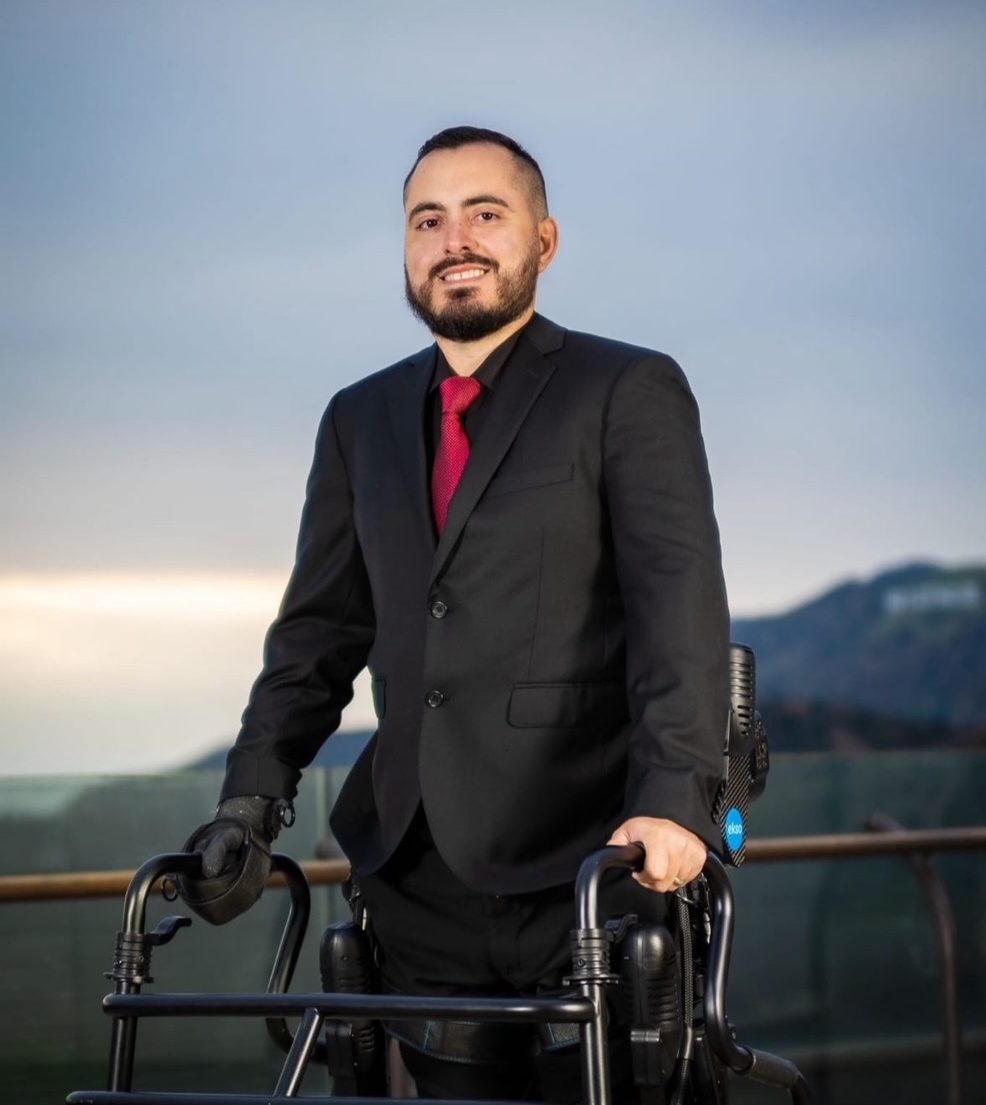
“I woke up from a coma, from a traumatic brain injury, where my family was told that I may possibly not even have the ability to think or speak or have any cognitive capacity,” Montoya said. Instead, he woke with his mind almost entirely intact.
What he woke up to was a body that would not move. His injury left him technically half-paraplegic, half-quadriplegic. A brachial plexus injury tore the nerve roots connecting his right arm to his spinal cord, leaving it permanently paralyzed, while his left arm works fully. He uses a power wheelchair.
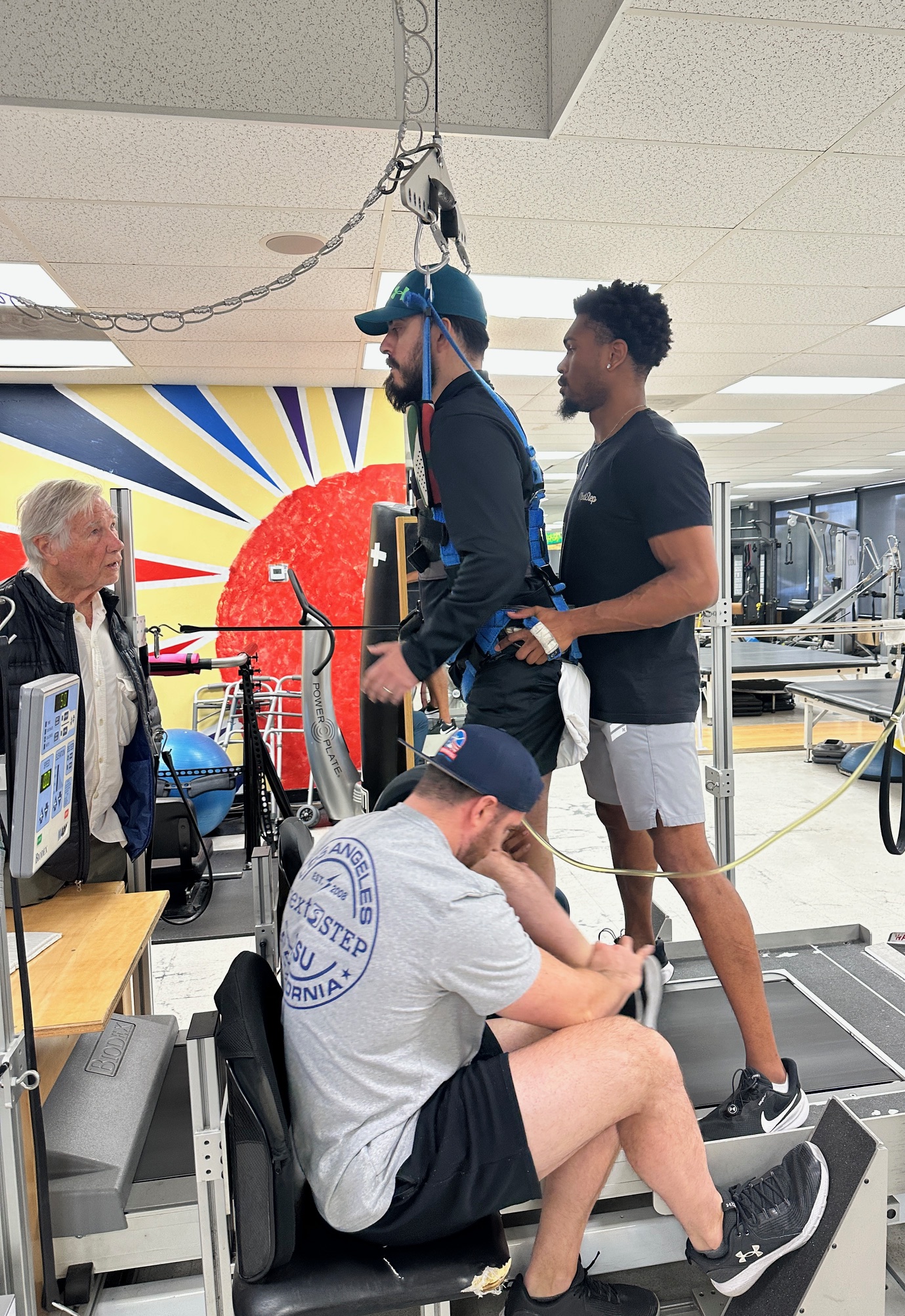
For about 10 years, he was classified AIS A, or complete, on the American Spinal Injury Association Impairment Scale, which carries very little chance of recovery. Around 2022, he regained proprioception, the ability to sense his body’s position without looking. He could then step in an EksoNR exoskeleton, shifting his weight while holding a walker, with robotic assistance cut to about 50% alongside transcutaneous spinal cord stimulation. This summer, he was reclassified AIS B/C and can voluntarily activate muscles below his injury, enough to register on electromyography sensors. “It tells me the nervous system was still capable of change years after I was told it wasn’t,” he said.
An Atlanta rehab hospital had told him a complete injury meant no meaningful recovery, and insurance wouldn’t cover treadmill-based stepping. Paralyzed Veterans of America (PVA) connected him with support that first year and later helped him establish his service connection. He now serves on the board of the PVA Research Foundation.
In 2020, Montoya moved to Los Angeles for a 10-month study at the University of California, Los Angeles (UCLA). It became six years as a mentee of the late Dr. Reggie Edgerton, whose research showed the spinal cord can relearn movement. Montoya became a researcher, earning master’s degrees from Georgia Tech and California State University, Los Angeles. He is now a Presidential Fellow in the joint Georgia Tech and Emory University biomedical engineering Ph.D. program, studying why physical gains don’t automatically translate into everyday participation. His research pairs activity-based training with noninvasive spinal stimulation, which changes the state of the remaining circuits rather than repairing the cord.
Building What Doesn’t Exist Yet
Through his research and his own recovery, Montoya noticed a gap. Many spinal cord injury treatment centers, including Department of Veterans Affairs (VA) facilities, lack the specialized exoskeletons or locomotor training setups he credits for his progress. Independent community rehabilitation centers that offer this therapy often charge $130 to $375 an hour out of pocket.
His first answer was Forever in Motion, a plan to lease neurorehabilitation exoskeletons to community rehabilitation centers, developed with support from PVA’s Self-Employment Program. “It helped me put together the idea in a PowerPoint slide,” he said.
The idea has since grown into the Freedom to Move Foundation, a nonprofit now being established in Atlanta. Rather than placing equipment in clinics, it aims to help veterans and others living with paralysis access advanced mobility technology and use it beyond therapy, for exercise, recreation, education and community life, and to address barriers such as cost, reimbursement, transportation and building design. The long-term vision is a community mobility center in Atlanta. Its motto: “Beyond rehabilitation. Into life.”
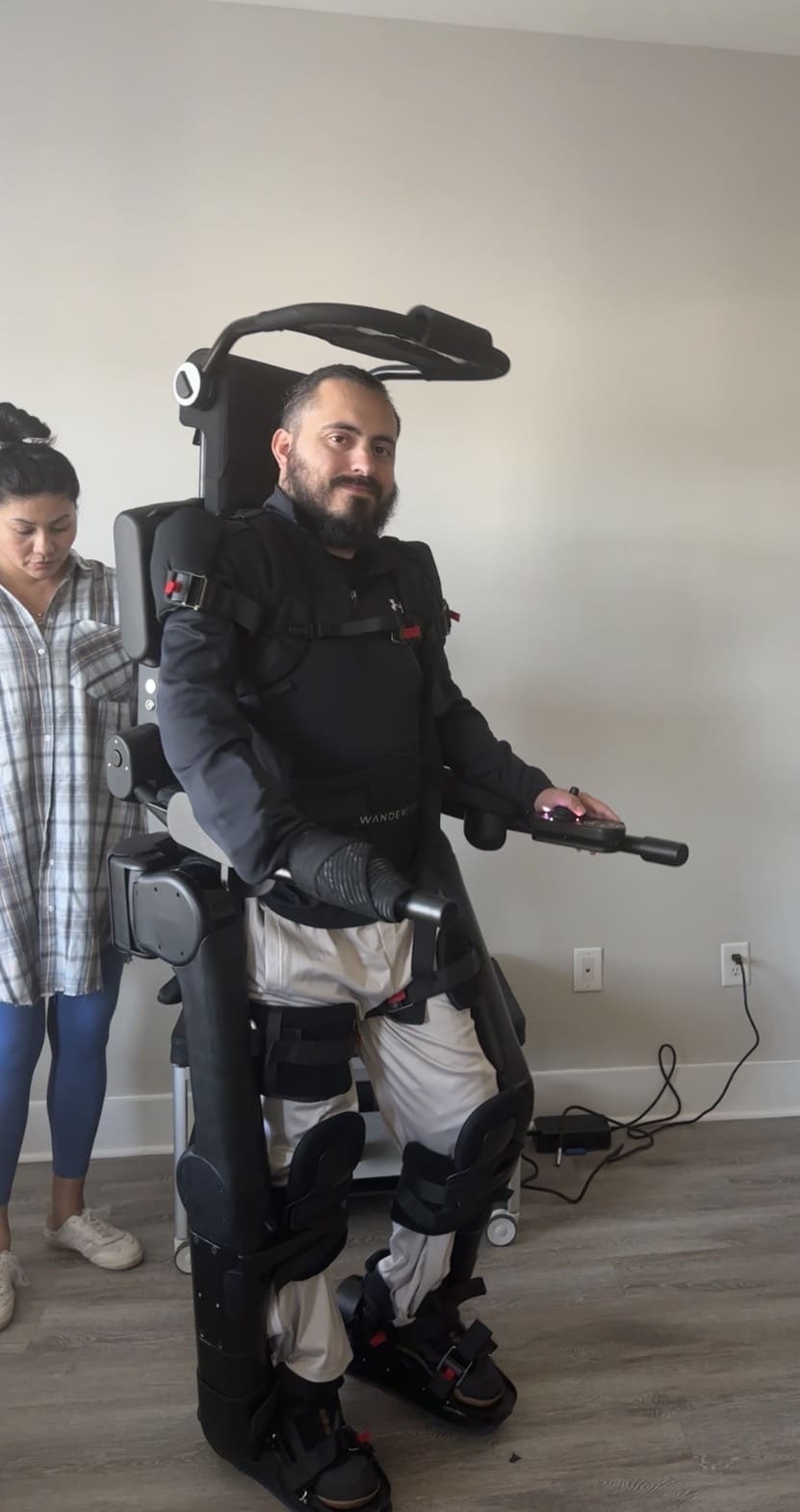
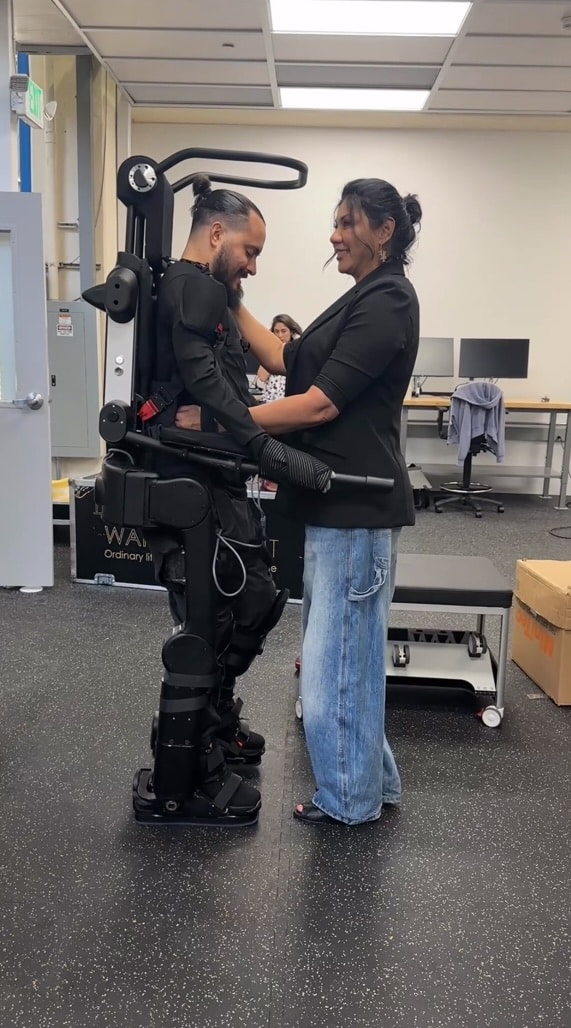
Montoya is also a Wandercraft ambassador, and he recently became what the company says is the first veteran to have its EVE personal exoskeleton purchased through the VA. His wife, Hilda, an industrial engineer turned certified exoskeleton trainer who worked alongside him in Edgerton’s lab, is his required companion when he walks in EVE and will serve as the foundation’s director of mobility programs and operations.
More than a decade after doctors told him his injury left no room for hope, Montoya has built a research career, three degrees with a doctorate underway, a marriage and now a foundation. He’s careful not to hold up his own story as proof that everyone will follow the same path. What it shows him, he said, is that chronic spinal cord injury shouldn’t be treated as a fixed endpoint.
“My goal is to change the standard of care for paralysis,” he said. It’s a mission, he added, born directly from the darkest days after his accident, when he was told there was nothing more that could be done.
“My goal since then has been to demonstrate the opposite.”
For Montoya, that means more than walking. “Freedom to move leads to freedom to participate,” he said, “and freedom to participate leads to freedom to live.”
Looking for your next step? If you’re a veteran interested in building a new career, exploring new opportunities, or starting a business, PVA’s Veterans Career Program can help.